


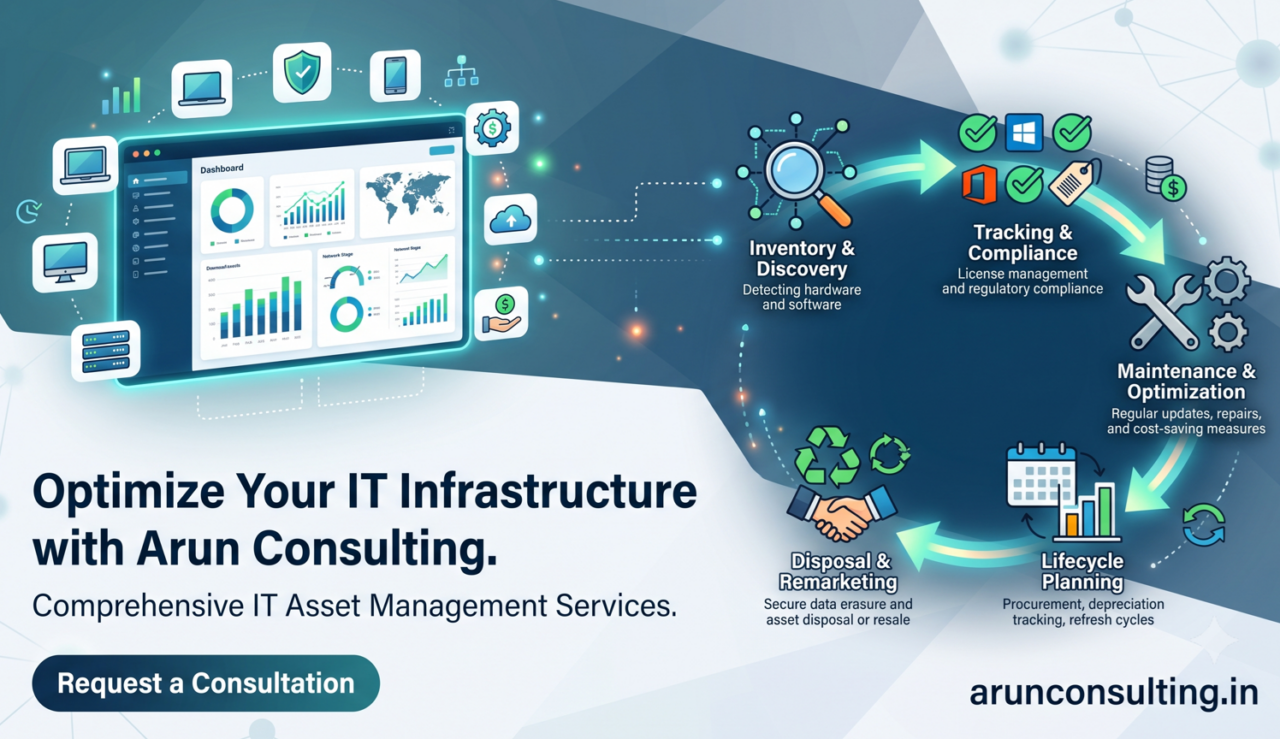
IT Asset Management helps businesses account for every laptop, server, license, and cloud subscription they’re paying for — not just list what they own, but control what it costs and how exposed it leaves them. With a disciplined IT Asset Management program in place, companies spend less on software they don’t use, close security gaps before they become incidents, and walk into compliance audits with answers instead of guesses.
Most businesses don’t run into trouble because they lack technology. They run into trouble because nobody has a current, accurate picture of the technology they already have. A growing company might be paying for laptops nobody remembers issuing, software licenses that renewed automatically and never got used, and cloud subscriptions three different teams signed up for separately. That gap — between what’s on the books and what’s actually running — is exactly what IT Asset Management is built to close.
Bangalore’s mix of software firms, fintechs, manufacturers, and fast-scaling mid-sized companies makes this harder, not easier. Teams adopt new cloud tools on their own, remote and hybrid staff need equipment issued and tracked outside a central office, and companies inherit legacy systems through growth or acquisition. It usually starts with the same question as any IT Systems Assessment: what do we actually have, and who’s accountable for it?
What Is IT Asset Management?
IT Asset Management (ITAM) is the practice of tracking, controlling, and optimizing every technology asset a business owns or pays for, from the moment it’s acquired to the day it’s retired. That includes physical hardware like laptops, servers, and networking equipment, along with software licenses, cloud infrastructure, and the growing list of SaaS subscriptions teams sign up for independently.
Done properly, ITAM answers questions most businesses assume they already know the answer to:
- What hardware, software, and cloud services do we actually have?
- Who is using each asset, and do they still need it?
- Are we paying for licenses or subscriptions nobody uses?
- Which assets are approaching end-of-life or end-of-support?
- Could we prove, to an auditor or a customer, exactly what’s running in our environment?
ITAM is broader than a simple inventory list. It connects asset data to cost, security, and compliance, which is why it typically sits alongside — not underneath — a company’s broader IT strategy rather than as a side task for whoever has spare time.
Why IT Asset Management Matters for Growing Businesses
The pressure to get ITAM right has grown for a few specific reasons.
Software and SaaS Costs Are Quietly Climbing
Cloud and SaaS tools are easy to adopt and easy to forget about. Industry research has repeatedly found that businesses waste a meaningful share of their software budgets — commonly estimated at a quarter to a third — on licenses and subscriptions that are duplicated, unused, or simply forgotten after the person who signed up for them changes roles. Multiply that across dozens of tools and renewal cycles, and it adds up to a real, recoverable cost.
Shadow IT Is a Security Blind Spot
When teams buy software independently — a project management tool here, an AI writing assistant there — none of it goes through a security review, and most of it never reaches IT’s radar. Analysts at Gartner have estimated that shadow IT can account for roughly a third or more of total technology spending in large organizations, and the same pattern shows up at smaller scale. Every tool IT doesn’t know about is a tool nobody is patching, backing up, or reviewing for data risk.
Compliance and Audit Requirements Are Tightening
Frameworks like ISO 27001 and SOC 2 both require a maintained, accurate asset inventory as a baseline control — you can’t secure or govern what you can’t see. In India, the phased rollout of the Digital Personal Data Protection (DPDP) Act adds another layer: businesses increasingly need to show exactly which systems hold personal data and who’s responsible for them. Our Compliance & Standards engagements with clients almost always start with this same asset-visibility gap.
Growth Multiplies Small Problems
A messy spreadsheet is manageable at 20 employees. At 200, across multiple offices and remote staff, the same approach breaks down completely. Companies that build ITAM discipline early can scale their headcount and their technology footprint without the process falling apart at exactly the moment it matters most.
The IT Asset Lifecycle
ITAM treats every asset as something with a beginning, middle, and end, rather than a line item that appears once on a purchase order and is never looked at again.
- Plan and procure. New requests are checked against what the business already owns before anything is purchased, avoiding duplicate tools and unnecessary spend.
- Deploy and onboard. Hardware and software is configured, assigned to a named owner, and logged in a central record the moment it goes live — not weeks later.
- Manage and maintain. Assets are patched, licensed correctly, monitored for usage, and reassigned when people change roles or leave.
- Optimize. Usage data drives decisions on renewals, downgrades, and consolidation, cutting licenses nobody uses instead of renewing everything by default.
- Retire and dispose. Hardware is wiped and disposed of securely, licenses are formally cancelled, and the asset record is closed out — not left active and unaccounted for.
Core Components of an ITAM Program
Hardware Asset Management
Physical devices — laptops, desktops, servers, networking equipment — tracked from purchase through disposal, with a clear owner and location recorded at every stage. This is the part of ITAM most people picture first, and it’s the easiest to let slide, right up until an audit or a security incident makes the gaps obvious.
Software and License Management
Keeping licensing terms, seat counts, and renewal dates in one place, matched against who’s actually using each tool. This is where most of the recoverable cost in ITAM tends to sit, since license waste is common and rarely visible without deliberate tracking.
Cloud and SaaS Governance
Cloud subscriptions and SaaS tools now make up a growing share of most companies’ technology footprint, and they don’t show up in a hardware inventory. Governance here means knowing what’s been provisioned, by whom, and whether it’s still needed, before the renewal invoice arrives.
A Central Asset Record
Whether it’s a dedicated ITAM platform or a well-maintained configuration database, every asset needs one system of record that ties hardware, software, and ownership together, instead of the information being scattered across spreadsheets, email threads, and individual team members’ memory.
Security and Compliance Alignment
Asset data feeds directly into patching schedules, access reviews, and audit evidence. When ITAM and security work from the same asset record, compliance reporting becomes a matter of pulling a report instead of a weeks-long scramble.
Benefits of a Strong ITAM Program
The case for ITAM isn’t abstract. It shows up directly in cost, risk, and how smoothly the business runs day to day.
Lower Software and Hardware Spend
Cutting unused licenses, avoiding duplicate tools, and right-sizing hardware refresh cycles typically frees up a meaningful share of the IT budget — money that’s often already been spent and simply hasn’t been recovered.
Reduced Security and Compliance Risk
An accurate, current asset inventory is one of the most basic controls auditors and security frameworks ask for, and one of the most commonly missing. Getting it right closes a gap that shows up in nearly every security review.
Faster, Cleaner Onboarding and Offboarding
New hires get the right equipment and access from day one instead of week three. Departing employees have their access and licenses revoked immediately, instead of accounts sitting active for months after someone has left.
Better Budget Planning
With accurate lifecycle and usage data, IT spend becomes predictable instead of reactive. Leadership can plan hardware refreshes and software renewals months in advance rather than absorbing a large, unexpected invoice.
A Foundation for Scalable Growth
Businesses that build ITAM discipline early can add offices, headcount, and new tools without the process breaking down. The system scales with the business instead of becoming something that has to be rebuilt from scratch later.
Where ITAM Programs Commonly Go Wrong
Most companies don’t fail at ITAM because they don’t see the value. They fail because of a handful of avoidable habits.
- Relying on spreadsheets. Manual tracking falls out of date the moment someone buys a new tool or a laptop changes hands, and nobody notices until the data is already wrong.
- Tracking hardware but ignoring the cloud. SaaS and cloud subscriptions are just as much an asset as a laptop, but they’re far easier to overlook since nothing physical ever crosses a desk.
- No clear ownership. If asset management is “everyone’s job,” it quietly becomes no one’s job, and the inventory drifts out of date within months.
- Skipping end-of-life planning. Assets that are never formally retired stay in the inventory, the budget, and sometimes the network, long after anyone is using them.
- Treating it as a one-time project. ITAM only works as an ongoing discipline. A clean inventory taken once and never updated is out of date within a quarter.
Choosing the Right ITAM Partner
Not every IT provider treats asset management as a strategic discipline — plenty still treat it as a spreadsheet exercise bolted onto a support contract. When evaluating a partner, look for:
- A methodical, documented approach to discovery, not a one-time scan
- Experience connecting ITAM to security and compliance requirements, not just cost
- The ability to tailor the program to your size and industry, not a generic template
- A focus on getting the program actually running, not just handing over a report
- Clear, measurable outcomes you can track over time
The right partner treats your asset data as the foundation for better decisions elsewhere in the business, not as a compliance checkbox to clear once and forget.
Final Thoughts
IT Asset Management rarely gets discussed with the same urgency as cybersecurity or digital transformation, but it quietly supports both. You can’t secure what you can’t see, and you can’t plan a technology roadmap around assets nobody has properly counted.
For businesses in Bangalore managing growth, hybrid teams, and increasing compliance pressure, a disciplined ITAM program is one of the more straightforward ways to cut cost and risk at the same time. It typically starts with an honest IT Systems Assessment to establish what you actually have, followed by ongoing advisory support to keep the inventory accurate as the business changes.
If you’re not sure how much visibility your business currently has into its own IT assets, get in touch — that’s exactly the kind of gap worth finding before an audit or an incident finds it for you.