


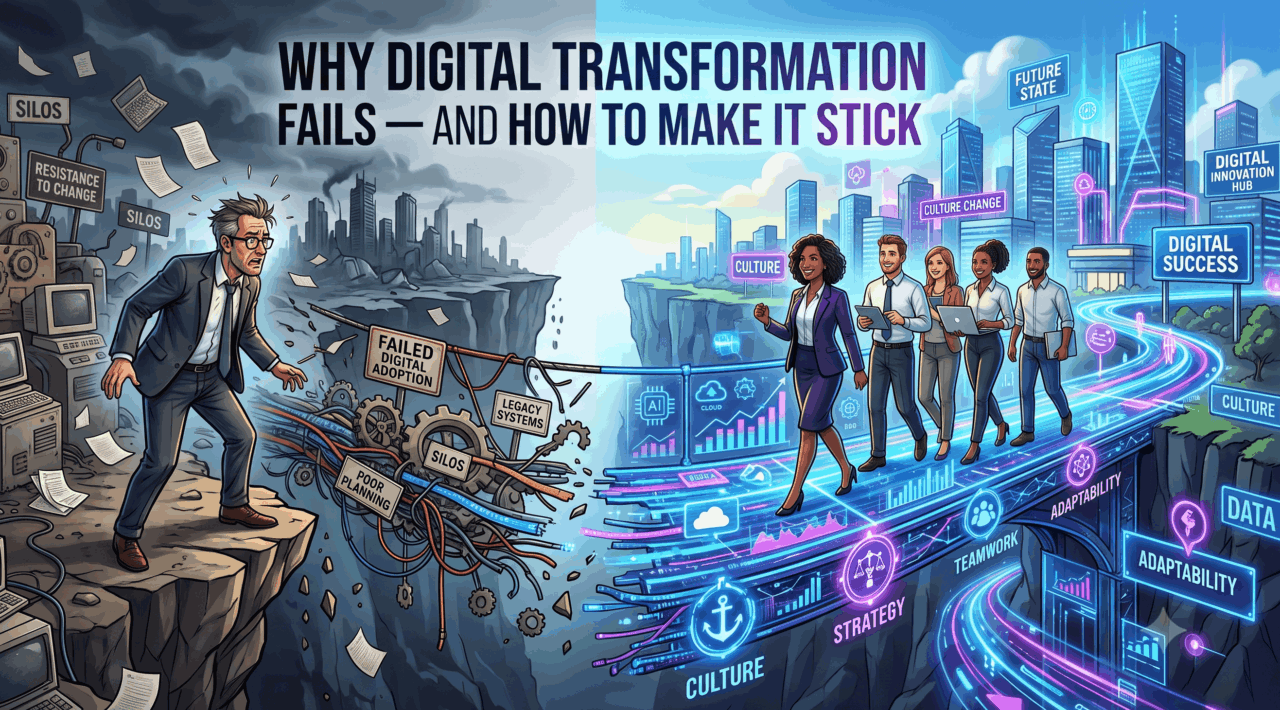
Why Digital Transformation Fails — And How to Make It Stick
For mid-sized firms in Bangalore, the gap between ambition and execution is where transformation lives or dies.
Every business leader knows digital transformation is important. The harder question is: why do so many initiatives start strong and fade into shelfware, budget overruns, or systems that teams simply refuse to use?
At Arun Consulting, we work with growing enterprises across Bangalore — from manufacturing and services to technology firms and global capability centers.
The pattern is consistent. The ambition is real. The budget is often there. What’s missing is usually something quieter: alignment, governance, and a clear line from technology decision to business outcome.
Here is what we have learned about making digital transformation actually work.
The Real Problem Is Rarely the Technology
Most businesses are not short on technology options. They are short on clarity about which technology actually serves them.
We have seen organizations invest in cloud platforms they do not fully utilize, implement ERP modules that duplicate existing workflows, or roll out collaboration tools that create more noise than efficiency.
In each case, the technology was sound. The problem was that no one stopped to ask: What business outcome are we solving for?
Digital transformation should not begin with a vendor demo. It should begin with an honest look at where your business is today, where friction lives, and what measurable improvement looks like.
Three Myths That Slow Mid-Sized Firms Down
Myth 1: Transformation means replacing everything
It does not. In most cases, the fastest path to value is optimizing what you already have, integrating disconnected systems, and retiring redundant tools. A full rip-and-replace is rarely the right first move.
Myth 2: It is only for large enterprises
Mid-sized firms often have an advantage: they can move faster, with less bureaucracy, and see results sooner. The key is discipline, not scale. A focused 90-day initiative with clear KPIs often delivers more value than a multi-year program with vague goals.
Myth 3: Once the system is live, the work is done
Go-live is a milestone, not a finish line. The real value of transformation shows up in the months after — when processes settle, teams adapt, and data starts telling a clearer story. Organizations that plan for this phase see 2–3x the return of those that do not.
What a Practical Transformation Looks Like
For most mid-sized firms in Bangalore, a successful digital transformation follows a simple rhythm:
Assess before you architect. Understand your current systems, processes, and risks. Know what is working, what is not, and where the hidden costs are.
Align before you invest. Every technology decision should tie back to a business outcome — reduced operational cost, faster customer response, better compliance posture, or improved decision-making speed.
Execute with governance. Strong program management, vendor coordination, and phased rollouts protect business continuity while change happens.
Optimize continuously. Measure what matters, refine processes, and treat transformation as an ongoing capability, not a one-time project.
The Bangalore Context
Bangalore’s business environment moves fast. Competition is intense, talent is mobile, and customer expectations shift quickly. In this market, digital transformation is not about keeping up with trends.
It is about building operational resilience — the ability to adapt without chaos, scale without breaking, and invest in technology that compounds value over time.
Enterprises here also face a unique mix of global compliance expectations and local operational realities. A transformation plan that ignores either side creates risk. One that integrates both creates confidence.
How to Know If You Are Ready
If you are asking any of the following questions, you are probably at the right moment to take a structured approach:
- Are we spending more on IT but seeing less business value?
- Do our teams work around our systems instead of with them?
- Is our current infrastructure creating compliance or security exposure?
- Are we making technology decisions reactively, without a clear roadmap?
- Do we have data, but struggle to turn it into actionable insight?
These are not signs of failure. They are signals that your business has outgrown its current technology foundation — and that a disciplined, outcome-focused transformation can unlock the next stage of growth.
From Strategy to Results
Digital transformation does not need to be overwhelming. What it needs is honesty about where you are, clarity about where you are going, and discipline in how you get there.
At Arun Consulting, we help businesses move from fragmented technology environments to integrated, scalable systems — with a focus on measurable outcomes, not just recommendations. Whether you are evaluating your first cloud migration, modernizing legacy systems, or building an IT strategy that supports long-term growth, the right approach is one that fits your business, your budget, and your pace.
Ready to turn digital strategy into business results?
Schedule a consultation at arunconsulting.in or write to us at contact@arunconsulting.in.